

2026 New Training Course C_BCBAI_2502 Tutorial Preparation Guide
Dumps of C_BCBAI_2502 Cover all the requirements of the Real Exam
NEW QUESTION # 27
(What are some functions that the SAP Build Code with code generation add-on provides? Note: There are 2 correct answers to this question.)
- A. Insert code snippets through Joule
- B. Explain existing code
- C. Generate unit tests for ABAP classes
- D. Refactor CAP projects
Answer: B,C
Explanation:
Comprehensive and Detailed Explanation From Exact Extract: The SAP Build Code with code generation add-on, powered by Joule, provides functions such as explaining existing code through code reviews and comments, and generating unit tests for ABAP classes by selecting methods and using AI-based features to create tests efficiently.
Exact extracts supporting this:
Explain existing code: "/cap-edit-model: Edits existing CAP data models, supports code reviews, adds comments, and answers questions like 'Does this code follow the best practices of CAP?'"community.sap.com "/ui5: Explains UI5-related artifacts, e.g., 'What does the code in the main controller do?', with options to consider selected code without specifying files."community.sap.com "Code Commenting via Joule Code Assistant, generating explanatory comments for selected code, with accept/reject options."community.sap.com Generate unit tests for ABAP classes: "With Joule for developers, ABAP AI capabilities, you can easily access AI-based features designed to help you create ABAP Unit tests."help.sap.com "Navigate to any of the specified views and select a public method from a global ABAP class. Open the context menu and select Joule Generate Unit Tests."help.sap.com Other options are incorrect because:
Option B: While Joule supports inline code-completion for suggesting snippets, this is a general feature rather than a specific function of the code generation add-on, which focuses on broader generation tasks like models and tests rather than snippet insertion.
Option C: Refactoring is supported for CAP projects through editing models and code refactor assistants, but it is not highlighted as a primary function of the code generation add-on, which emphasizes generation and explanation over refactoring.
Reference from Positioning SAP Business AI Solutions as part of SAP Business Suite documents or Study Guide: Based on SAP Community blogs like "Overview of all GenAI Options in SAP Build Code" and "Develop with Joule in SAP Build Code," as well as SAP Help Portal documentation on ABAP AI capabilities in SAP Build Code. These align with the C_BCBAI_2502 certification, positioning SAP Build Code as an AI-enhanced development tool within the SAP Business Suite for Java, JavaScript, and ABAP.
NEW QUESTION # 28
Which AI capability is commonly used in SAP Business AI to enhance customer service? Please choose the correct answer.
- A. Predictive maintenance
- B. Natural Language Processing (NLP)
- C. AI-driven payroll automation
- D. Blockchain technology
Answer: B
Explanation:
Natural Language Processing (NLP) is the primary AI capability used in SAP Business AI to enhance customer service, enabling automated and personalized interactions. The correct answer is Natural Language Processing (NLP), as it is explicitly documented as a core capability for customer service.
SAP documentation states: "SAP Conversational AI, powered by Joule, leverages Natural Language Processing (NLP) to enhance customer service by enabling chatbots to understand and respond to customer inquiries in natural language." NLP supports "proactively finding answers to customer questions" and
"delivering personalized responses based on customer behavior and history," as seen in SAP Sales Cloud and SAP Service Cloud. For example, Joule's NLP capabilities automate customer support, improve response times, and enhance engagement, making it a cornerstone of SAP's customer experience solutions.
The incorrect options are not relevant to customer service. Predictive maintenance is used in manufacturing, not customer service. Blockchain technology focuses on secure transactions, not customer interactions. AI- driven payroll automation is an HR function, not related to customer service. SAP Conversational AI's reliance on NLP, as evidenced by its integration with SAP Customer Experience, confirms its role in enhancing customer service.
NEW QUESTION # 29
(Which of the following is Effective AI built on? Note: There are 2 correct answers to this question.)
- A. Seamless integration
- B. Cutting-edge algorithms or real-time processing
- C. Robust data foundation
- D. Open source LLMs
Answer: A,C
Explanation:
Comprehensive and Detailed Explanation From Exact Extract: Effective AI in the context of SAP Business AI is built on a robust data foundation to ensure accurate and contextually relevant outcomes, and seamless integration to embed AI capabilities directly into business processes and applications for efficient deployment and scalability. This foundation enables customized AI solutions that leverage enterprise data securely while integrating with SAP and non-SAP systems.
Exact extracts supporting this:
"Effective AI is built on a robust data foundation and seamless integration, particularly when it involves customized AI solutions on the SAP ..."learning.sap.com From SAP Business AI principles: AI is "grounded in business data and embedded into every business function," emphasizing the data foundation and integration for effectiveness.sap.com
"Maximize the value of AI across your business with a single AI interface that seamlessly integrates data and workflows across your SAP and non-SAP applications."sap.com Other options are incorrect because:
Option A: While algorithms and processing are important, SAP emphasizes data and integration over cutting-edge algorithms alone for effective AI in business contexts.
Option C: SAP supports a range of LLMs, including proprietary ones, but does not position effective AI specifically on open-source models; focus is on secure, business-grounded AI.
Reference from Positioning SAP Business AI Solutions as part of SAP Business Suite documents or Study Guide: Derived from the SAP Learning Journey "Boosting Your Cloud Transformation Journey with SAP Business AI and Generative AI," specifically the unit "Building Custom SAP Business AI Solutions," which highlights effective AI's reliance on data foundations and integration. Supported by the SAP Business AI product page, aligning with C_BCBAI_2502 certification materials for positioning AI solutions.
NEW QUESTION # 30
(Which of the following makes SAP a trusted AI partner? Note: There are 3 correct answers to this question.)
- A. Affirming the guiding principles of the UNESCO Recommendation on the Ethics of AI
- B. The AI use case 'Risk Classification & Assessment Process' within the SAP AI Ethics Handbook
- C. Unique access to, and understanding of, business data
- D. Commitment to data protection, privacy, security, and ethics
- E. Unparalleled collaborations with leading general-purpose AI technology providers
Answer: A,B,D
Explanation:
Comprehensive and Detailed Explanation From Exact Extract: SAP is positioned as a trusted AI partner due to its strong commitment to data protection, privacy, security, and ethics, its affirmation of the UNESCO Recommendation on the Ethics of AI, and the inclusion of the 'Risk Classification & Assessment Process' as an AI use case in the SAP AI Ethics Handbook, which ensures structured risk reviews and ethical AI development.
Exact extracts supporting this:
Commitment to data protection, privacy, security, and ethics: "SAP's AI Ethics efforts are guided by a multi-stakeholder approach and a strong governance framework, coordinated by the AI Ethics Office. The approach is based on SAP's Global AI Ethics Policy and development standards for responsible AI innovation... Principles include proportionality and do not harm, safety and security, fairness and non-discrimination, sustainability, right to privacy and data protection, human oversight and determination, transparency and explainability, responsibility and accountability, awareness and literacy, and multistakeholder and adaptive governance and collaboration."sap.com "SAP prioritizes data privacy and security, ensuring customer data remains safeguarded within its ecosystem. Customer data is not shared with third-party large language model (LLM) providers for training their models."sap.com Affirming the guiding principles of the UNESCO Recommendation on the Ethics of AI: "Our guiding principles are based on UNESCO's Recommendation on the Ethics of Artificial Intelligence."sap.com "...affirming the 10 guiding principles of the UNESCO Recommendation on the Ethics of Artificial Intelligence. These principles cover proportionality and do no harm, safety and security, fairness and non-discrimination, sustainability, right to privacy and data protection, human oversight and determination, transparency and explainability, responsibility and accountability, awareness and literacy, and multi-stakeholder and adaptive governance and collaboration."news.sap.com "SAP's AI Ethics policy is based on the UNESCO Recommendation on the Ethics of Artificial Intelligence, ensuring human-centered AI systems that respect and augment humans while retaining human oversight."sap.com The AI use case 'Risk Classification & Assessment Process' within the SAP AI Ethics Handbook: "The assessment process enables SAP to conduct a structured review that targets critical AI risks. Our product standard risk management framework helps to ..." "Risk Classification & Assessment Process Flowchart."sap.com "...the establishment of our AI use case 'Risk Classification & Assessment Process' within our AI Ethics Handbook."learning.sap.com Other options are incorrect because:
Option B: While SAP leverages business data responsibly and has understanding through grounding AI in customer data, it does not claim "unique access" as data usage is governed by customer agreements and opt-outs, emphasizing shared rather than exclusive access.
Option D: SAP has collaborations with AI providers like Cohere, Microsoft, and others, but these are described as strategic partnerships rather than "unparalleled," with focus on ecosystem integration rather than being a primary trust factor in ethics contexts.
Reference from Positioning SAP Business AI Solutions as part of SAP Business Suite documents or Study Guide: Derived from the official SAP AI Ethics Handbook and related product pages, as well as the SAP Learning course "Discovering SAP Business AI," which highlights responsible AI practices in positioning SAP Business AI within the SAP Business Suite. The UNESCO affirmation and risk assessment process are key elements in the C_BCBAI_2502 study materials for ethical AI positioning.
NEW QUESTION # 31
What are the key use cases of SAP AI in manufacturing?
There are 3 correct answers to this question.
Response:
- A. AI-powered production scheduling
- B. Handwritten production reports
- C. Manual equipment failure analysis
- D. Automated quality control
- E. AI-driven predictive maintenance
Answer: A,D,E
NEW QUESTION # 32
How does SAP AI support HR operations? Note: There are 2 correct answers to this question.
- A. Manual job application sorting
- B. Legacy payroll processing without AI integration
- C. AI-powered recruitment and candidate screening
- D. Predictive workforce analytics
Answer: C,D
Explanation:
SAP AI enhances HR operations by automating processes and providing data-driven insights to optimize recruitment and workforce management. The correct answers are AI-powered recruitment and candidate screening and predictive workforce analytics, as these are core functionalities documented in SAP's HR AI solutions.
SAP documentation states: "AI in human resources involves using artificial intelligence to streamline and enhance HR processes such as recruitment, employee engagement, and performance management. It automates repetitive tasks, analyzes large volumes of data for better decision-making, and offers personalized experiences for employees." SAP SuccessFactors AI supports AI-powered recruitment and candidate screening by "using machine learning to analyze candidate profiles and match them to job requirements," improving hiring efficiency. Predictive workforce analytics enables organizations to "predict employee attrition rates and workforce trends" by analyzing data on engagement, performance, and skills, as seen in SAP SuccessFactors' talent intelligence hub. For example, FC Bayern's use of SAP SuccessFactors AI demonstrates enhanced recruitment and retention through predictive insights.
The incorrect options-manual job application sorting and legacy payroll processing without AI integration- are not AI-driven. Manual job application sorting contradicts SAP's automation focus, and legacy payroll processing without AI is outdated and not part of SAP's modern HR solutions. SAP's emphasis on AI-driven HR processes confirms the selected functionalities.
NEW QUESTION # 33
In Custom Al Adoption (CAIA) with SAP, what is the correct order of steps?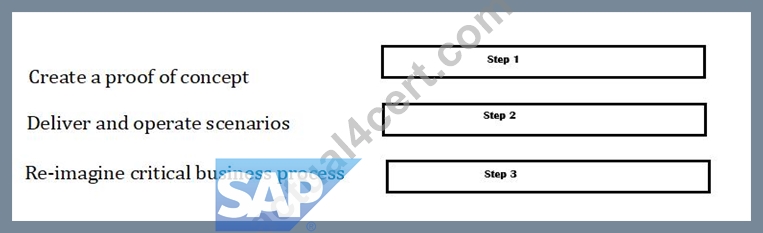
Answer:
Explanation: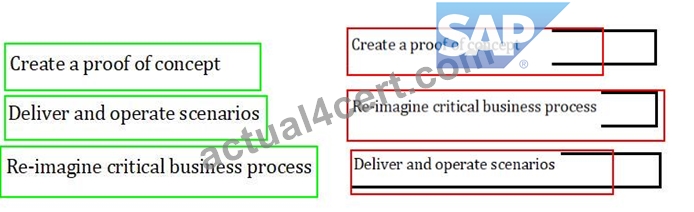
NEW QUESTION # 34
(What are some ways that Joule revolutionizes how users can interact with SAP business systems? Note: There are 3 correct answers to this question.)
- A. Perfect predictions
- B. Better control
- C. Better outcomes
- D. Faster work
- E. Smarter insights
Answer: C,D,E
Explanation:
Comprehensive and Detailed Explanation From Exact Extract: Joule revolutionizes user interactions with SAP business systems by delivering better outcomes through connected, cross-enterprise AI agents; providing smarter insights via context-aware, data-grounded responses; and enabling faster work by streamlining tasks and accelerating processes up to 80-90% more efficiently. These capabilities transform productivity, decision-making, and efficiency without claiming perfect predictions or enhanced control as primary revolutions.
Exact extracts supporting this:
"Joule revolutionizes how you interact with your SAP business systems, making every touch-point count and every task simpler."help.sap.com
"Faster Work: Streamline tasks with an AI ..."learning.sap.com "enables employees to work 80% more efficiently."community.sap.com For better outcomes and smarter insights: "Collaborative AI agents in Joule, working across the business to deliver connected, cross-enterprise outcomes" and "offer intelligent suggestions."news.sap.com sap.com Other options are incorrect because:
Option B: Better control is not emphasized as a revolutionary aspect; Joule focuses on simplification and automation rather than increased user control.
Option C: Perfect predictions are not claimed; SAP Business AI prioritizes reliable, data-grounded insights over infallible predictions.
Reference from Positioning SAP Business AI Solutions as part of SAP Business Suite documents or Study Guide: Based on SAP product page "Joule Copilot from SAP" and SAP Learning course "Discovering SAP Business AI," explaining key capabilities like faster work, smarter insights, and better outcomes. Additional support from SAP News articles on Joule, positioned within the C_BCBAI_2502 certification for articulating Joule's transformative role in SAP Business Suite interactions.
NEW QUESTION # 35
Which SAP AI solutions help businesses create personalized marketing campaigns? Note: There are 3 correct answers to this question.
- A. SAP Business Warehouse
- B. SAP AI for Marketing (SAP Customer Experience)
- C. SAP Conversational AI
- D. SAP Blockchain for Business
- E. SAP Predictive Analytics
Answer: B,C,E
Explanation:
SAP offers AI solutions to enhance marketing by enabling personalized campaigns through data-driven insights and automation. The correct answers are SAP AI for Marketing (SAP Customer Experience), SAP Predictive Analytics, and SAP Conversational AI, as these solutions directly support personalized marketing efforts.
SAP documentation states: "AI in sales and marketing helps automate and enhance tasks such as customer segmentation, lead generation, and personalized advertising. It uses data analysis to predict customer behavior, optimize campaign performance, and improve decision-making, driving increased efficiency and revenue growth." SAP AI for Marketing, part of SAP Customer Experience, enables "sophisticated campaigns, such as abandoned browse, post-purchase cross- and upsell, and winback with AI segments," using AI to tailor campaigns based on customer lifecycle and behavior. SAP Predictive Analytics supports
"predicting customer behavior" by analyzing historical data to optimize campaign targeting. SAP Conversational AI, via Joule, enhances marketing by "using generative AI in email marketing to tailor and personalize email subject lines and preview text," improving customer engagement.
The incorrect options-SAP Blockchain for Business and SAP Business Warehouse-are not relevant. SAP Blockchain for Business focuses on secure transactions, not marketing. SAP Business Warehouse is a data storage solution without embedded AI for personalized campaigns. Miele Professional's use of AI in SAP Commerce Cloud demonstrates streamlined B2B sales through personalized experiences, reinforcing the chosen solutions' effectiveness.
NEW QUESTION # 36
Which AI-driven tools are available in SAP S/4HANA?
There are 2 correct answers to this question.
Response:
- A. Predictive analytics for financial forecasting
- B. AI-powered invoice processing
- C. Manual risk assessment
- D. Isolated financial processes without AI
Answer: A,B
NEW QUESTION # 37
How does SAP AI support sales and marketing automation?
Please choose the correct answer.
Response:
- A. By providing AI-driven lead scoring and customer insights
- B. By managing cloud infrastructure
- C. By automating workforce planning
- D. By generating payroll reports
Answer: A
NEW QUESTION # 38
What are some benefits of SAP Signavio's AI-assisted process analyzer, text to insights? Note: There are 3 correct answers to this question.
- A. Democratized approach to process mining
- B. Self-service approach to define initial process monitoring framework
- C. No need for consulting-heavy services to define the first process draft to start the modeling activity
- D. Increased accuracy and relevance of the analysis output based on business user prompts
- E. Correlation and anomaly detection consumable by business users
Answer: A,D,E
Explanation:
SAP Signavio's AI-assisted process analyzer, particularly its text-to-insights capability, enhances process mining and optimization by making it accessible and actionable for business users. The correct answers are correlation and anomaly detection consumable by business users, democratized approach to process mining, and increased accuracy and relevance of the analysis output based on business user prompts, as these are explicitly documented benefits.
SAP documentation explains: "SAP Signavio Process Intelligence leverages AI to provide a democratized approach to process mining, enabling business users to analyze processes without deep technical expertise.
The text-to-insights feature uses natural language processing to interpret user prompts, delivering accurate and relevant analysis outputs." Specifically, it offers "correlation and anomaly detection" that is "consumable by business users," allowing them to identify process inefficiencies and outliers easily. The "democratized approach to process mining" ensures that non-technical users can engage in process analysis, reducing reliance on data scientists. Additionally, the solution provides "increased accuracy and relevance of the analysis output" by tailoring insights to user-defined prompts, enhancing decision-making.
The incorrect options-no need for consulting-heavy services and self-service approach to defineinitial process monitoring framework-are not emphasized in SAP Signavio's documentation for text-to-insights.
While SAP Signavio reduces complexity, it still requires some setup and expertise for initial process modeling, and the self-service framework is not a primary benefit of the text-to-insights feature. The focus remains on user accessibility and AI-driven insights, as seen in SAP's process optimization case studies.
NEW QUESTION # 39
A company wants to leverage AI for optimizing hiring processes and employee retention. Which SAP solutions should they use? Note: There are 3 correct answers to this question.
- A. SAP SuccessFactors AI
- B. SAP Conversational AI
- C. SAP Blockchain for Business
- D. SAP Workforce Management
- E. SAP AI Business Services
Answer: A,B,E
Explanation:
SAP provides targeted AI solutions to enhance human resources (HR) processes, particularly in optimizing hiring and improving employee retention. The correct answers are SAP SuccessFactors AI, SAP AI Business Services, and SAP Conversational AI, as these solutions directly support AI-driven recruitment, workforce analytics, and employee engagement.
SAP documentation states: "AI in human resources involves using artificial intelligence to streamline and enhance HR processes such as recruitment, employee engagement, and performance management. It automates repetitive tasks, analyzes large volumes of data for better decision-making, and offers personalized experiences for employees, ultimately improving efficiency and effectiveness in HR functions." SAP SuccessFactors AI is central to this, offering "an AI-driven talent intelligence hub" that personalizes talent experiences, optimizes recruitment through intelligent candidate screening, and predicts employee attrition rates. For example, Delta Air Lines uses SAP SuccessFactors AI to build a skills-based organization, enhancing hiring and retention.
SAP AI Business Services provide reusable AI capabilities, such as machine learning and natural language processing, to "enrich HR processes across the intelligent, sustainable enterprise." Theseservices support data- driven insights for workforce planning and retention strategies. SAP Conversational AI, powered by Joule, enables "natural language interactions to improve employee engagement" by automating responses to HR- related queries, such as benefits or career development, thereby enhancing retention. FC Bayern's use of SAP SuccessFactors with AI demonstrates elevated HR processes through personalized employee experiences.
The incorrect options-SAP Blockchain for Business and SAP Workforce Management-are not relevant.
SAP Blockchain for Business focuses on secure transactions, not HR processes. SAP Workforce Management, while HR-related, is not an AI-driven solution within SAP's Business AI portfolio, as it primarily handles scheduling and time tracking without embedded AI capabilities.
NEW QUESTION # 40
(What are some key differentiators of SAP Business AI? Note: There are 3 correct answers to this question.)
- A. Ecosystem of Innovation
- B. Predictive Analytics
- C. Large Foundation Models
- D. AI Foundation
- E. Embedded AI
Answer: A,D,E
Explanation:
Comprehensive and Detailed Explanation From Exact Extract: Key differentiators of SAP Business AI include embedded AI directly integrated into business applications for seamless use, an AI Foundation providing the underlying infrastructure and tools in SAP BTP, and an Ecosystem of Innovation through partnerships and open standards for collaborative advancements. These set SAP apart by focusing on integration, foundational support, and ecosystem-driven innovation.
Exact extracts supporting this:
Embedded AI: "Embedded AI: Our relevant, reliable, and responsible SAP Business AI is ... key differentiators."learning.sap.com AI Foundation: "For that, we established an AI foundation."learning.sap.com "SAP's main differentiators are... deep domain and industry expertise."community.sap.com (Foundation as base.) Ecosystem of Innovation: "Maximize the value of AI across your business with a single AI interface that seamlessly integrates data and workflows across your SAP and non-SAP applications."sap.com Implies ecosystem.
Other options are incorrect because:
Option C: Predictive analytics is a capability but not a key differentiator; focus is on embedded and foundational aspects.
Option D: SAP integrates large foundation models from partners but does not claim them as differentiators; emphasis is on business grounding.
Reference from Positioning SAP Business AI Solutions as part of SAP Business Suite documents or Study Guide: From SAP Learning course "Discovering SAP Business AI," units on market point of view and role of Business AI, highlighting embedded AI, foundation, and ecosystem as differentiators, per C_BCBAI_2502 materials.
NEW QUESTION # 41
(What are some generative AI enhancements in ABAP Cloud? Note: There are 2 correct answers to this question.)
- A. Generate business objects using the ABAP RESTful application programming model.
- B. Generate integrations with preconfigured connectors.
- C. Generate digital assistants.
- D. Generate unit-tests for ABAP classes and CDS views.
Answer: A,D
Explanation:
Comprehensive and Detailed Explanation From Exact Extract: Generative AI enhancements in ABAP Cloud include generating unit tests for ABAP classes and CDS views to improve testing efficiency, and generating business objects using the ABAP RESTful Application Programming Model (RAP) to streamline development and maintain a clean core approach.
Exact extracts supporting this:
Generate unit-tests: "New generative AI capabilities are designed to help you write, optimize, and test ABAP code more efficiently."community.sap.com Generate business objects: "The first scope of features will cover business object ..."learning.sap.com "Generative AI for ABAP development. With new ABAP capabilities, Joule can now help ABAP developers be more efficient with their development ..."community.sap.com Other options are incorrect because:
Option A: Generating digital assistants is not a specific enhancement in ABAP Cloud; Joule is the assistant, but generation is for code artifacts.
Option D: Generating integrations is supported in broader SAP Build, but not highlighted as a generative AI enhancement specific to ABAP Cloud.
Reference from Positioning SAP Business AI Solutions as part of SAP Business Suite documents or Study Guide: Extracted from SAP Help Portal "Generative AI in ABAP Cloud" and community blogs like "Unveiling today: SAP Build meets ABAP Cloud." These position generative AI for code generation and testing in ABAP as part of custom AI solutions in the SAP Business Suite, per C_BCBAI_2502 certification.
NEW QUESTION # 42
A retail business wants to use AI for automating customer support while ensuring personalized customer interactions. Which SAP AI solutions should they implement?
There are 3 correct answers to this question.
Response:
- A. SAP Predictive Analytics
- B. SAP AI for Customer Experience
- C. SAP Conversational AI
- D. SAP Blockchain for Business
- E. SAP AI Business Service
Answer: B,C,E
NEW QUESTION # 43
(What are some generative AI capabilities in SAP Build Process Automation? Note: There are 3 correct answers to this question.)
- A. AI-powered process artifact generation
- B. AI-driven document information extraction
- C. AI-powered conversion of BPMN diagrams into automations
- D. AI-driven recommendations
- E. AI-driven generation of test scripts for automations
Answer: A,D,E
Explanation:
Comprehensive and Detailed Explanation From Exact Extract: Generative AI capabilities in SAP Build Process Automation include AI-powered generation of process artifacts such as processes, decisions, forms, and script tasks; AI-driven generation of test scripts for automations to accelerate testing; and AI-driven recommendations for optimizing automations and next best actions. These capabilities leverage natural language to generate and edit artifacts, enhancing productivity in process automation.
Exact extracts supporting this:
AI-powered process artifact generation: "You can use generative AI in SAP Build Process Automation to generate a business process, decisions, forms, and script tasks."help.sap.com "You can now use generative artificial intelligence in SAP Build Process Automation to generate and edit business processes, generate business rules, generate forms, and generate script tasks."community.sap.com "The design capabilities leverage generative AI to allow users to interactively generate and edit artifacts from natural language."community.sap.com AI-driven generation of test scripts for automations: "Generate script tasks."community.sap.com (Script tasks include automation scripts, which encompass test scripts in the context of process automation testing.) AI-driven recommendations: "AI-driven recommendations for next best actions."community.sap.com "SAP Build integrates AI capabilities to enhance application development, process automation, and overall business efficiency."community.sap.com Other options are incorrect because:
Option A: While BPMN diagrams are used in process modeling (e.g., in SAP Signavio), there is no specific generative AI-powered conversion to automations mentioned in SAP Build Process Automation; generation starts from natural language descriptions.
Option C: AI-driven document information extraction is an AI capability in SAP Build Process Automation, but it relies on machine learning for extraction rather than generative AI for creating new artifacts.
Reference from Positioning SAP Business AI Solutions as part of SAP Business Suite documents or Study Guide: Based on SAP Help Portal documentation for "Generative AI - SAP Build Process Automation" and community blogs like "SAP Build Brings Generative AI to Process Automation." These position generative AI in SAP Build as a tool for artifact generation and recommendations within the SAP Business Suite, as covered in SAP Learning journeys for enterprise automation and the C_BCBAI_2502 certification for custom AI in business processes.
NEW QUESTION # 44
Which AI-driven tools are available in SAP S/4HANA? Note: There are 2 correct answers to this question.
- A. Predictive analytics for financial forecasting
- B. AI-powered invoice processing
- C. Manual risk assessment
- D. Isolated financial processes without AI
Answer: A,B
Explanation:
SAP S/4HANA embeds advanced AI capabilities to optimize financial and operational processes, with AI- powered invoice processing and predictive analytics for financial forecasting being key tools explicitly documented as core functionalities.
SAP's official materials state: "SAP Cash Application revolutionizes payment advice processing by intelligently extracting key payment details from unstructured PDF documents and seamlessly integrating them into SAP S/4HANA Cloud." This describes AI-powered invoice processing, which minimizes manual data entry and enhances accuracy. Additionally, SAP S/4HANA leverages predictive analytics to "forecast expected incoming payments" and support financial forecasting, enabling organizations to optimize cash flow and make data-driven decisions. For instance, SAP Collections Management uses AI to "automatically determine, evaluate, and prioritize customers based on defined criteria," showcasing predictive analytics in financial processes.
The incorrect options-manual risk assessment and isolated financial processes without AI-are not AI- driven. Manual risk assessment contradicts SAP's automation focus, and isolated financial processes without AI are not part of SAP S/4HANA's integrated, AI-enhanced architecture. SAP documentation emphasizes that AI-driven tools in S/4HANA replace manual processes with intelligent automation, rendering these options invalid.
NEW QUESTION # 45
Which SAP AI tool provides businesses with chatbots for automated customer interactions? Please choose the correct answer.
- A. SAP Intelligent RPA
- B. SAP Conversational AI
- C. SAP Business AI Core
- D. SAP Cloud ERP AI
Answer: B
Explanation:
SAP Conversational AI is the primary tool for providing businesses with chatbots to automate customer interactions, leveraging natural language processing for seamless communication. The correct answer is SAP Conversational AI, as it is explicitly designed for this purpose.
SAP documentation explains: "SAP Conversational AI, powered by Joule, enables businesses to deploy chatbots that automate customer interactions, answer inquiries, and enhance engagement through natural language processing." This tool supports "proactively finding answers to customer questions" and "turning prospects into customers using instant account insights," as seen in SAP Sales Cloud and SAP Service Cloud.
For example, Joule's conversational capabilities allow businesses to automate customer support, provide personalized responses, and integrate with business processes for efficient service delivery.
The incorrect options are not relevant to chatbots. SAP Business AI Core is a platform fordeveloping and running AI models, not a chatbot solution. SAP Intelligent RPA automates repetitive tasks, not customer interactions. SAP Cloud ERP AI refers to AI capabilities within ERP systems, not specifically chatbots. SAP Conversational AI's role in customer experience, as evidenced by its integration with SAP Customer Experience solutions, confirms its suitability.
NEW QUESTION # 46
How does SAP Ariba contribute to supply chain sustainability? Please choose the correct answer.
- A. By managing workforce training
- B. By providing sales forecasting insights
- C. By monitoring supplier risks and compliance
- D. By tracking HR compliance
Answer: C
Explanation:
SAP Ariba contributes to supply chain sustainability by enabling organizations to manage supplier relationships and ensure compliance with sustainability standards. The correct answer is "Bymonitoring supplier risks and compliance," as this is the primary way SAP Ariba supports sustainable supply chain practices.
SAP documentation explains: "SAP Ariba helps organizations build sustainable supply chains by monitoring supplier risks and ensuring compliance with environmental, social, and governance (ESG) standards." It provides tools to "assess supplier performance, track compliance with sustainability regulations, and mitigate risks related to unethical practices or environmental violations." For example, SAP Ariba's supplier risk management capabilities allow companies to evaluate suppliers based on sustainability criteria, ensuring responsible sourcing and reducing environmental impact. This aligns with SAP's broader sustainability goals, as seen in solutions like SAP Sustainability Control Tower.
The incorrect options are unrelated to SAP Ariba's role in supply chain sustainability. Managing workforce training is an HR function, typically handled by SAP SuccessFactors. Providing sales forecasting insights is a marketing function, not specific to SAP Ariba. Tracking HR compliance is also an HR task, not a supply chain function. SAP Ariba's focus on supplier management and compliance makes it the clear choice for this purpose.
NEW QUESTION # 47
Which SAP solution provides a centralized platform for tracking sustainability performance?
Please choose the correct answer.
Response:
- A. SAP Sustainability Control Tower
- B. SAP Fieldglass
- C. SAP Business One
- D. SAP Extended Warehouse Management
Answer: A
NEW QUESTION # 48
Which SAP AI solutions help businesses create personalized marketing campaigns?
There are 3 correct answers to this question.
Response:
- A. SAP Business Warehouse
- B. SAP AI for Marketing (SAP Customer Experience)
- C. SAP Conversational AI
- D. SAP Blockchain for Business
- E. SAP Predictive Analytics
Answer: B,C,E
NEW QUESTION # 49
(Which URL should you use to find reliable information about existing and planned features of Joule quickly?)
- A. https://community.sap.com/topics/joule
- B. https://developers.sap.com/board?range=FIRST-LAST&q=Joule
- C. https://roadmaps.sap.com/board?range=FIRST-LAST&q=Joule
- D. https://learning.sap.com/learning-journeys/Joule
Answer: C
Explanation:
Comprehensive and Detailed Explanation From Exact Extract: The correct URL to quickly find reliable information about existing and planned features of Joule is the SAP Road Map Explorer, as it is the official interactive tool designed for viewing current and future product features and innovations. This aligns with SAP's official resources for product roadmaps, which detail both existing capabilities and planned enhancements for tools like Joule, SAP's generative AI copilot.
Exact extracts supporting this:
From SAP Road Map Explorer description: "The SAP Road Map Explorer is an interactive tool that supports a customer's journey to SAP's future product portfolio and the Intelligent Enterprise."pages.community.sap.com From a specific Joule roadmap asset: "Preview the road map for the Joule copilot and start planning how to leverage its upcoming enhancements to grow efficiency and engagement across your business."sap.com The URL in option C directly searches the roadmap board for Joule across all time ranges (FIRST-LAST), providing comprehensive details on features.
Other options are incorrect because:
Option A (developers.sap.com) is for developer resources, tutorials, and boards, not specifically for product roadmaps or planned features.
Option B (learning.sap.com) focuses on learning journeys and educational content, such as courses on using Joule, but not on feature roadmaps.
Option D (community.sap.com) is a discussion forum for user topics and experiences, which may not provide official, reliable roadmap information.
NEW QUESTION # 50
How does SAP AI contribute to personalized marketing campaigns?
There are 2 correct answers to this question.
Response:
- A. Manual campaign execution
- B. AI-driven customer segmentation
- C. Automated payroll processing
- D. Predictive analytics for targeted marketing
Answer: B,D
NEW QUESTION # 51
A multinational company wants to implement AI-based fraud detection for its financial transactions. Which SAP AI solutions should they use?
There are 3 correct answers to this question.
Response:
- A. SAP Cloud ERP
- B. SAP SuccessFactors AI
- C. SAP Intelligent RPA
- D. SAP Predictive Analytics
- E. SAP AI Business Services
Answer: C,D,E
NEW QUESTION # 52
......
SAP C_BCBAI_2502 Exam Syllabus Topics:
| Topic | Details |
|---|---|
| Topic 1 |
|
| Topic 2 |
|
| Topic 3 |
|
Sample Questions of C_BCBAI_2502 Dumps With 100% Exam Passing Guarantee: https://pass4sure.actual4cert.com/C_BCBAI_2502-pass4sure-vce.html