

Latest NSE7_PBC-7.2 Exam Dumps Fortinet Exam from Training Expert Actual4Cert
Pass Fortinet Fortinet NSE 7 - Public Cloud Security 7.2 PDF Dumps | Recently Updated 91 Questions
NEW QUESTION # 31
You are troubleshooting an Azure SDN connectivity issue with your FortiGate VM Which two queries does that SDN connector use to interact with the Azure management API? (Choose two.)
- A. There is only one query initiating from FortiGate port1 -
- B. Some queries are made to manage public IP addresses.
- C. The first query is targeted to a special IP address to get a token.
- D. The first query is targeted to IP address 8.8
Answer: B,C
Explanation:
The Azure SDN connector uses two types of queries to interact with the Azure management API. The first query is targeted to a special IP address to get a token. This token is used to authenticate the subsequent queries. The second type of query is used to retrieve information about the Azure resources, such as virtual machines, network interfaces, network security groups, and public IP addresses. Some queries are made to manage public IP addresses, such as assigning or releasing them from the FortiGate VM. Reference: Configuring an SDN connector in Azure, Azure SDN connector using service principal, Troubleshooting Azure SDN connector
NEW QUESTION # 32
You are troubleshooting an Azure SDN connectivity issue with your FortiGate VM Which two queries does that SDN connector use to interact with the Azure management API? (Choose two.)
- A. There is only one query initiating from FortiGate port1 -
- B. Some queries are made to manage public IP addresses.
- C. The first query is targeted to a special IP address to get a token.
- D. The first query is targeted to IP address 8.8
Answer: B,C
Explanation:
The Azure SDN connector uses two types of queries to interact with the Azure management API. The first query is targeted to a special IP address to get a token. This token is used to authenticate the subsequent queries. The second type of query is used to retrieve information about the Azure resources, such as virtual machines, network interfaces, network security groups, and public IP addresses. Some queries are made to manage public IP addresses, such as assigning or releasing them from the FortiGate VM. References: Configuring an SDN connector in Azure, Azure SDN connector using service principal, Troubleshooting Azure SDN connector
NEW QUESTION # 33
A customer would like to use FortiGate fabric integration With FortiCNP When configuring a FortiGate VM to add to FortiCNP, which three mandatory configuration steps must you follow on FortiGate? (Choose three.)
- A. Create and IPS sensor and a firewall policy
- B. Create an IPsec tunnel.
- C. Enable send logs-
- D. Create an SSL]SSH inspection profile.
- E. Enable two-factor authentication.
Answer: A,C,D
Explanation:
To configure a FortiGate VM to add to FortiCNP, you need to perform three steps on FortiGate:
Enable send logs in FortiGate to allow FortiCNP to receive the IPS logs from FortiGate.
Create an SSL/SSH inspection profile on FortiGate to inspect the encrypted traffic and apply IPS protection.
Create an IPS sensor and a firewall policy on FortiGate to enable IPS detection and prevention for the traffic.
Reference:
FortiCNP 22.4.a Administration Guide, page 22-24
FortiGate IPS Administration Guide, page 9-10
NEW QUESTION # 34
Refer to the exhibit.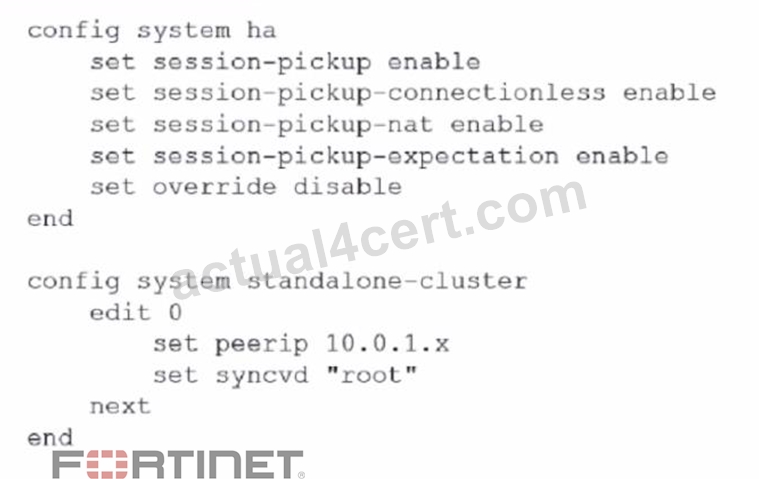
You deployed an HA active-active load balance sandwich with two FortiGate VMs in Microsoft Azure.
After the deployment, you prefer to use FGSP to synchronize sessions, and allow asymmetric return traffic In the environment, FortiGate port 1 and port 2 are facing external and internal load balancers respectively What IP address must you use in the peerip configuration?
- A. The internal load balancer port 1 IP address.
- B. The opposite FortiGate port 2 IP address.
- C. The opposite FortiGate port 1 IP address.
- D. The public load balancer port 2 IP address
Answer: B
Explanation:
HA Synchronization Requirements: FGSP requires direct communication between the FortiGates to synchronize the session table. This synchronization typically occurs over a dedicated HA link that connects the HA pair.
Asymmetric Traffic Considerations: FGSP allows asymmetric traffic to rejoin the correct session by synchronizing session information, including NAT and TCP sequence tracking between the FortiGate units in a cluster.
Configuration Specifics: For port 2, which is facing the internal load balancer, the peerip should be set to the corresponding port 2 IP address of the opposite FortiGate. This allows the internal interfaces to communicate directly with each other for session synchronization purposes, which is crucial in an active-active deployment to ensure sessions persist during failover scenarios.
Explanation:
In an HA active-active load balance configuration with FortiGate VMs, especially in Microsoft Azure where FGSP (FortiGate Session Life Support Protocol) is used for session synchronization, the correct configuration for the peerip is:
NEW QUESTION # 35
What are three important steps required to get Terraform ready using Microsoft Azure Cloud Shell? (Choose three.)
- A. Subscribe to Terraform in Azure.
- B. Use the wget (te=aform vession) command to upload Terraform.
- C. Set up a storage account in Azure.
- D. Move the Terraform file to the bin directory.
- E. use the -O command to download Terraform.
Answer: B,C,D
Explanation:
To get Terraform ready using Microsoft Azure Cloud Shell, you need to perform the following steps:
Set up a storage account in Azure. This is required to store the Terraform state file in a blob container, which enables collaboration and persistence of the infrastructure configuration1.
Use the wget (terraform_version) command to upload Terraform. This command downloads the latest version of Terraform from the official website and saves it as a zip file in the current directory2.
Move the Terraform file to the bin directory. This step extracts the Terraform executable from the zip file and moves it to the bin directory, which is part of the PATH environment variable. This allows you to run Terraform commands from any directory in Cloud Shell2.
The other options are incorrect because:
You do not need to use the -O command to download Terraform. This command is used to specify a different output file name for the downloaded file, but it is not necessary for this task3.
You do not need to subscribe to Terraform in Azure. Terraform is an open-source tool that can be used with any cloud provider, and there is no subscription or registration required to use it with Azure4. Reference:
Updating the route table and adding an IAM policy
Configure Terraform in Azure Cloud Shell with Bash
wget(1) - Linux man page
Terraform by HashiCorp
NEW QUESTION # 36
You have been tasked with deploying FortiGate VMs in a highly available topology on the Amazon Web Services (AWS) cloud. The requirements for your deployment are as follows:
- You must deploy two FortiGate VMs in a single virtual private cloud (VPC), with an external elastic load balancer which will distribute ingress traffic from the internet to both FortiGate VMs in an active-active topology.
- Each FortiGate VM must have two elastic network interfaces: one will connect to a public subnet and other will connect to a private subnet.
- To maintain high availability, you must deploy the FortiGate VMs in two different availability zones.
How many public and private subnets will you need to configure within the VPC?
- A. Two public subnets and one private subnet
- B. Two public subnets and two private subnets
- C. One public subnet and one private subnet
- D. One public subnet and two private subnets
Answer: B
NEW QUESTION # 37
A company deployed a FortiGate-VM with an on-demand license using Amazon Web Services (AWS) Market Place Cloud Formation template. After deployment, the administrator cannot remember the default admin password.
What is the default admin password for the FortiGate-VM instance?
- A. <blank>
- B. The instance-ID value
- C. The admin password cannot be recovered and the customer needs to deploy the FortiGate- VM again.
- D. admin
Answer: B
NEW QUESTION # 38
Refer to the exhibit. You attempted to access the Linux1 EC2 instance directly from the internet using its public IP address in AWS.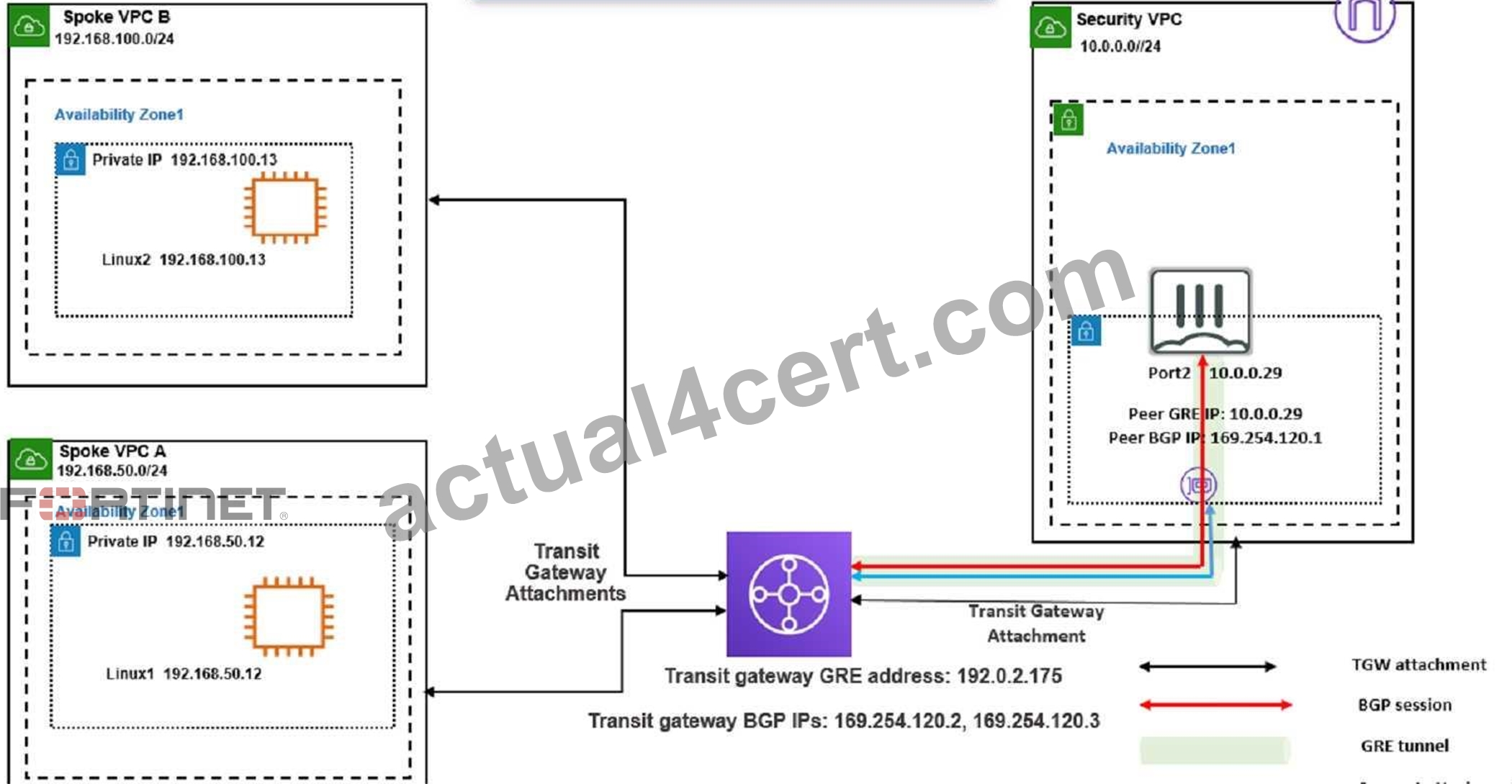
However, your connection is not successful.
Given the network topology, what can be the issue?
- A. There is no internet gateway attached to the Spoke VPC A.
- B. There is no elastic IP address attached to FortiGate in the Security VPC.
- C. There is no connection between VPC A and VPC B.
- D. The Transit Gateway BGP IP address is incorrect.
Answer: A
Explanation:
This is because the Linux1 EC2 instance is not accessible directly from the internet using its public IP address in AWS.
An internet gateway is a horizontally scaled, redundant, and highly available VPC component that allows communication between instances in your VPC and the internet. Without an internet gateway, the Linux1 EC2 instance cannot receive or send traffic to or from the internet, even if it has a public IP address assigned to it.
To fix this issue, you need to attach an internet gateway to the Spoke VPC A and configure a route table that directs internet-bound traffic to the internet gateway. You also need to ensure that the Linux1 EC2 instance has a security group that allows inbound and outbound traffic on the desired ports.
NEW QUESTION # 39
What kind of underlying mechanism does Transit Gateway Connect use to send traffic from the virtual private cloud (VPC) to the transit gateway?
- A. A GRE attachment
- B. Transit Gateway Connect attachment
- C. A transport attachment
- D. A BGP attachment
Answer: B
Explanation:
Transit Gateway Connect Specificity: AWS Transit Gateway Connect is a specific feature designed to streamline the integration of SD-WAN appliances and third-party virtual appliances into your Transit Gateway.expand_more It utilizes a specialized attachment type.exclamation BGP's Role: While Transit Gateway Connect attachments leverage BGP for dynamic routing, BGP itself is a routing protocol and not the core connectivity mechanism in this context. GRE Tunneling: GRE is a tunneling protocol commonly used with Transit Gateway Connect attachments to encapsulate traffic.
NEW QUESTION # 40
You are tasked with deploying a FortiGate HA solution in Amazon Web Services (AWS) using Terraform What are two steps you must take to complete this deployment? (Choose two.)
- A. Enable automation on the AWS portal.
- B. Create an AWS Active Directory user with permissions.
- C. Use CloudSheIl to install Terraform.
- D. Create an AWS Identity and Access Management (IAM) user With permissions.
Answer: C,D
Explanation:
To deploy a FortiGate HA solution in AWS using Terraform, you need to create an AWS IAM user with permissions to access the AWS resources and services required by the FortiGate-VM. You also need to use CloudShell to install Terraform, which is a tool for building, changing, and versioning infrastructure as code.
Reference:
Deploying FortiGate-VM using Terraform | AWS Administration Guide
Setting up IAM roles | AWS Administration Guide
Launching the instance using roles and user data | AWS Administration Guide Terraform by HashiCorp
NEW QUESTION # 41
Refer to the exhibit.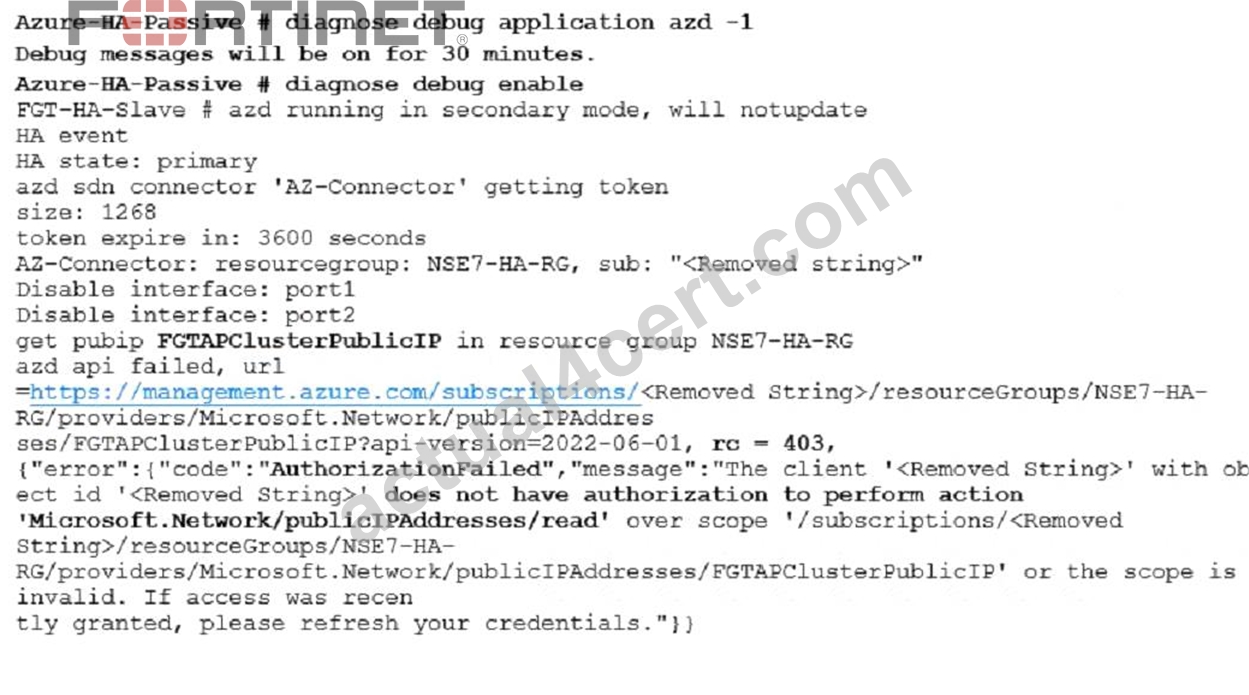
You are troubleshooting a FortiGate HA floating IP issue with Microsoft Azure. After the failover, the new primary device does not have the previous primary device floating IP address.
What could be the possible issue With this scenario?
- A. A wrong client secret credential is used
- B. The error is caused by credential time expiration.
- C. The Azure service principle account must have a contributor role.
- D. FortiGate port4 does not have internet access.
Answer: C
Explanation:
In this scenario, the issue is caused by the Azure service principle account nothaving a contributor role. This is required for the FortiGate HA floating IP to work properly. Without this role, the new primary device will not have the previous primary device floating IP address after failover. References: Fortinet Public Cloud Security knowledge source documents or study guide.
https://docs.fortinet.com/product/fortigate-public-cloud/7.2
NEW QUESTION # 42
Refer to the exhibit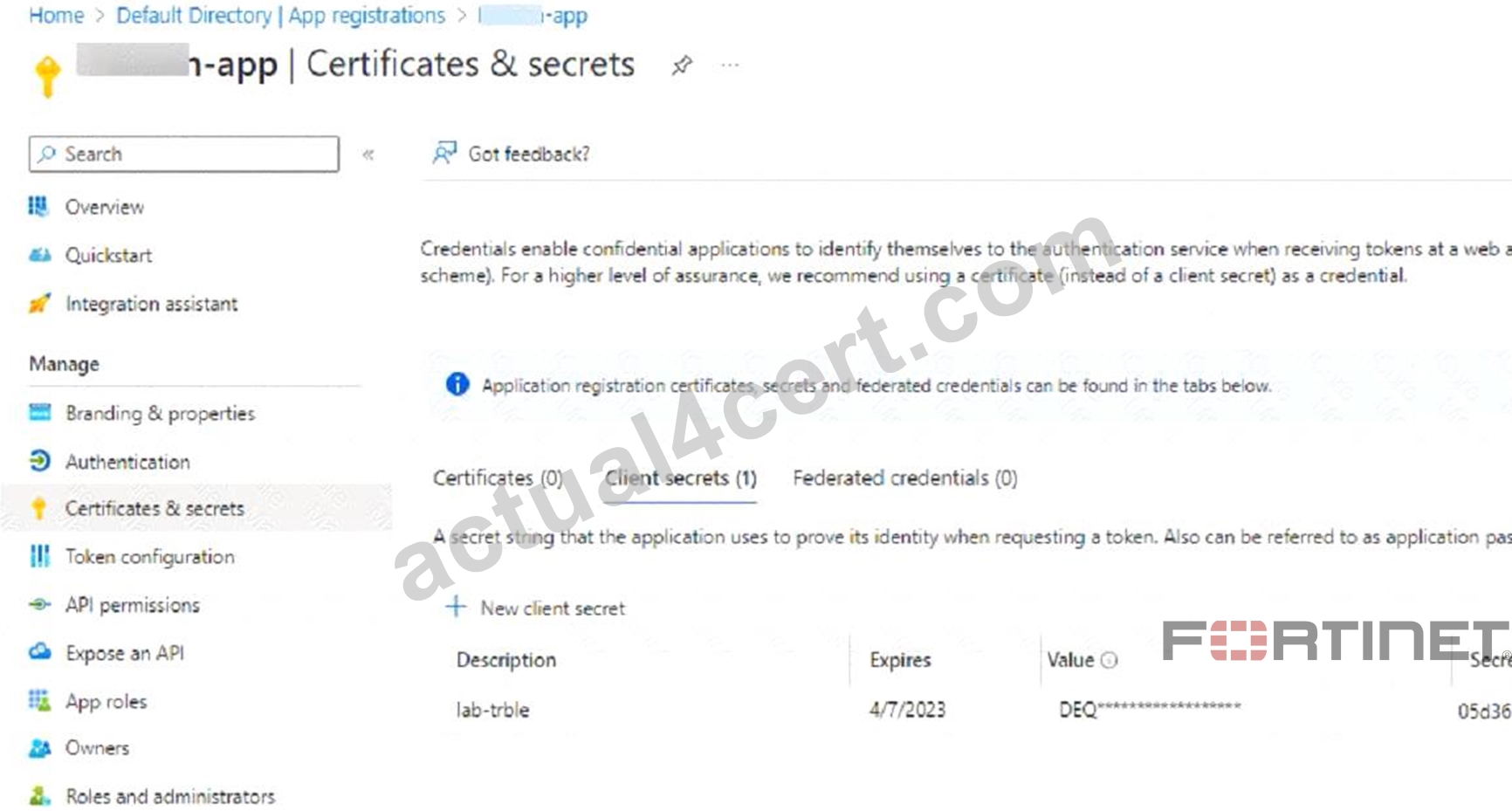
An administrator is trying to deploy a FortiGate VM in Microsoft Azure using Terraform However, during the configuration, the Azure client secret is no longer visible in the Azure portal.
How would the administrator obtain the Azure
client secret to configure on Terratorm?
- A. The administrator must obtain the client secret through Azure Cloud Shell.
- B. Log in to the Azure CLI with power user to obtain the client secret
- C. The administrator can create a new client secret
- D. The administrator must create a new Azure account
Answer: C
Explanation:
The Azure client secret is a one-time value that is only visible when it is created. If the administrator loses or forgets the client secret, they cannot retrieve it from the Azure portal. However, they can create a new client secret and use it to configure Terraform. To create a new client secret, they need to follow these steps12:
* Sign in to the Azure portal and navigate to the Azure Active Directory service.
* Select the application name under the App Registrations.
* Select Certificates & Secrets > New client secret to create a new client secret.
* Add a description and an expiration date for the client secret and select Add.
* Copy the value of the new client secret immediately as it will not be shown again.
References:
* Generate new Client Secret and link to key-vault | Microsoft Learn
* Azure Quickstart - Set and retrieve a secret from Key Vault using Azure portal | Microsoft Learn
NEW QUESTION # 43
Which statement about immutable infrastructure in automation is true?
- A. It is the practice of deploying two parallel servers for high availability.
- B. It is the practice of modifying the existing server configuration after it is deployed
- C. It is the practice of deploying a new server for every configuration change
- D. It is the practice of applying hotfixes and OS patches after deployment
Answer: C
Explanation:
The statement that best describes the concept of immutable infrastructure in the context of automation is:
A . It is the practice of deploying a new server for every configuration change.
Immutable Infrastructure Concept: This approach to infrastructure management involves replacing servers or components entirely rather than making changes to existing configurations once they are deployed. When a change is needed, a new server instance is provisioned with the desired configuration and the old one is decommissioned after the new one is successfully deployed and tested.
Benefits: Immutable infrastructure minimizes the risks associated with in-place updates, such as inconsistencies or failures due to configuration drift. It enhances reliability and predictability by ensuring that the deployed environment matches exactly what was tested in staging. This practice is particularly aligned with modern deployment strategies like blue/green or canary deployments.
NEW QUESTION # 44
You are tasked with deploying a FortiGate HA solution in Amazon Web Services (AWS) using Terraform What are two steps you must take to complete this deployment? (Choose two.)
- A. Enable automation on the AWS portal.
- B. Create an AWS Active Directory user with permissions.
- C. Use CloudSheIl to install Terraform.
- D. Create an AWS Identity and Access Management (IAM) user With permissions.
Answer: C,D
Explanation:
Explanation
To deploy a FortiGate HA solution in AWS using Terraform, you need to create an AWS IAM user with permissions to access the AWS resources and services required by the FortiGate-VM. You also need to use CloudShell to install Terraform, which is a tool for building, changing, and versioning infrastructure as code.
References:
Deploying FortiGate-VM using Terraform | AWS Administration Guide
Setting up IAM roles | AWS Administration Guide
Launching the instance using roles and user data | AWS Administration Guide Terraform by HashiCorp
NEW QUESTION # 45
Refer to the exhibit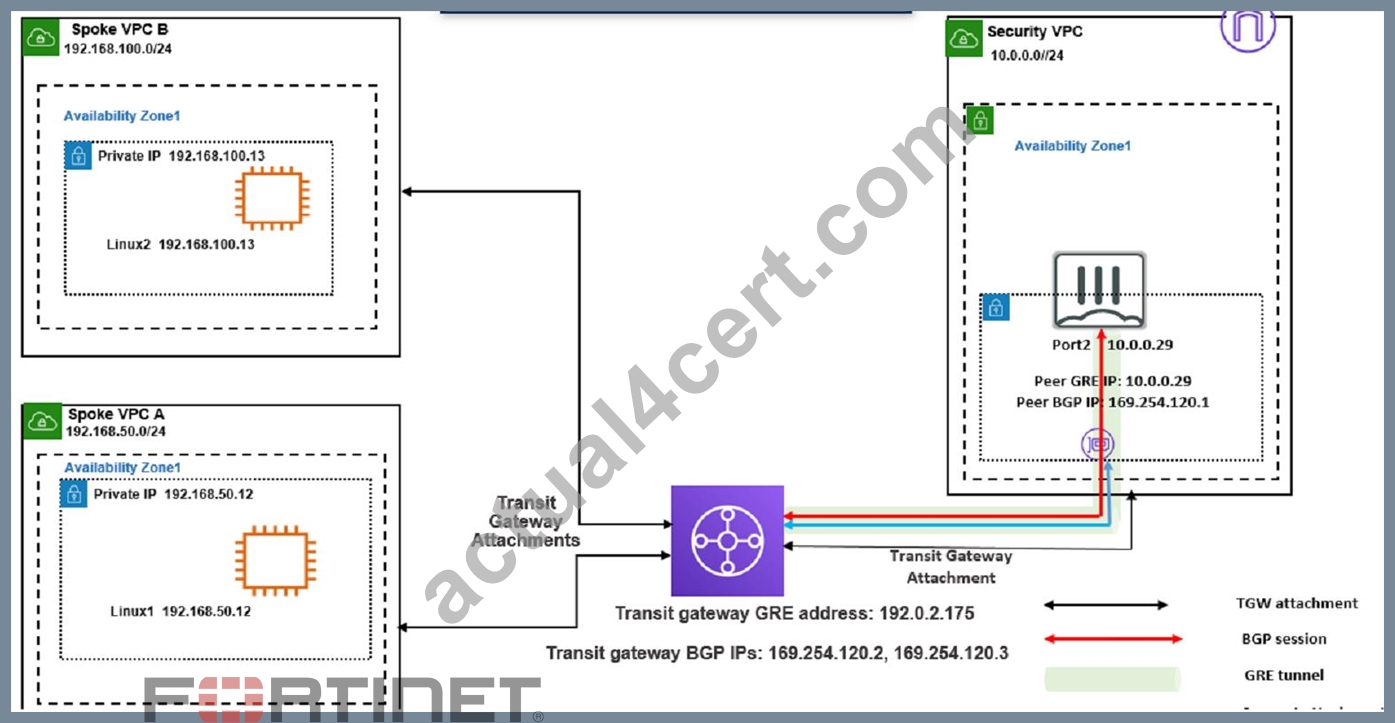
You attempted to access the Linux1 EC2 instance directly from the internet using its public IP address in AWS.
However, your connection is not successful.
Given the network topology, what can be the issue?
- A. There is no internet gateway attached to the Spoke VPC A.
- B. There is no elastic IP address attached to FortiGate in the Security VPC.
- C. There is no connection between VPC A and VPC B.
- D. The Transit Gateway BGP IP address is incorrect.
Answer: A
Explanation:
This is because the Linux1 EC2 instance is not accessible directly from the internet using its public IP address in AWS.
An internet gateway is a horizontally scaled, redundant, and highly available VPC component that allows communication between instances in your VPC and the internet. Without an internet gateway, the Linux1 EC2 instance cannot receive or send traffic to or from the internet, even if it has a public IP address assigned to it.
To fix this issue, you need to attach an internet gateway to the Spoke VPC A and configure a route table that directs internet-bound traffic to the internet gateway. You also need to ensure that the Linux1 EC2 instance has a security group that allows inbound and outbound traffic on the desired ports.
: [Internet Gateways - Amazon Virtual Private Cloud] : [Attach an Internet Gateway to Your VPC - Amazon Virtual Private Cloud] : [Security Groups for Your VPC - Amazon Virtual Private Cloud]
NEW QUESTION # 46
Refer to the exhibit.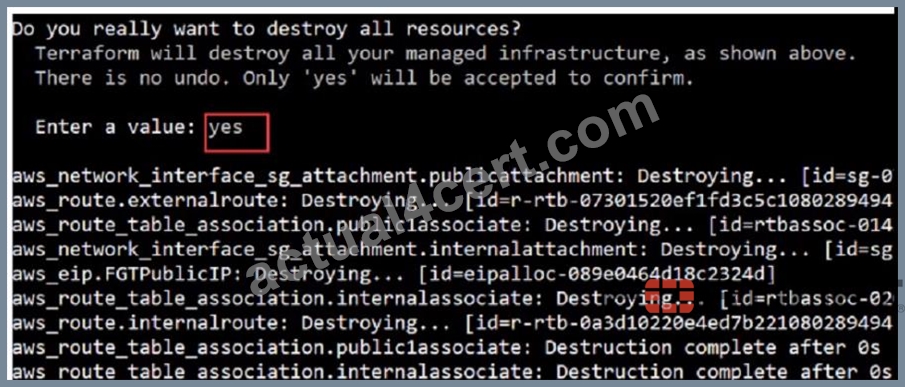
What would be the impact of confirming to delete all the resources in Terraform?
- A. It destroys all the resources in the resource group
- B. It destroys all the resources in the . tfvars file
- C. It destroys all the resources in the state file.
- D. It destroys all the resources tied to the AWS Identity and Access Management (1AM) user.
Answer: C
Explanation:
Terraform State File Role: The terraform.tfstate file contains a real-time mapping of the resources that Terraform manages, including their current configuration and relationships. This file tracks the actual state of resources provisioned by Terraform.
Impact of Destruction: When Terraform prompts for confirmation to destroy resources, and 'yes' is entered, Terraform reads the state file and systematically removes all the resources that are managed as part of that state. This is not limited to a specific .tfvars file, IAM user, or resource group-it is a global action that affects all resources tracked by the state file associated with the current Terraform workspace and configuration.
Explanation:
Confirming to delete all the resources in Terraform will have the following impact:
NEW QUESTION # 47
Refer to the exhibit.
An administrator has deployed a FortiGate VM in Amazon Web Services (AWS) and is trying to access it using its public IP address from their local computer However, the connection is not successful and at the same time FortiGate is not receiving any HTTPS or SSH traffic to its external interface What should the administrator check for possible issue?
- A. Check the inbound network security group rules
- B. Check the FortiGate firewall policies
- C. Check the FortiGate instance ID
- D. Run a debug flow to check any network ACLs
Answer: A
Explanation:
Considering the situation where the administrator is unable to access the FortiGate VM using its public IP address and no traffic is reaching the FortiGate's external interface, the administrator should check:
D:Check the inbound network security group rules.
* Network Security Group Rules:AWS uses security groups as a virtual firewall that controls inbound and outbound traffic to AWS resources such as EC2 instances. If the FortiGate VM's public interface is not receiving HTTPS or SSH traffic, it's likely because the inbound security group rules associated with that interface are not allowing access on the necessary ports (HTTPS - port 443, SSH - port 22).
* Troubleshooting:The administrator should verify that the security group rules for the FortiGate VM's network interface allow inbound traffic on the specific ports used for management access. If these rules are absent or misconfigured, the intended traffic will be blocked, resulting in the inability to connect.
References:The role of security groups in network traffic management is a core concept in AWS and is outlined in AWS documentation. Checking security group rules is a standard troubleshooting step when dealing with connectivity issues to AWS resources.
NEW QUESTION # 48
Refer to Exhibit:
The exhibit shows the Connect Peers settings on Amazon Web Services (AWS) transit gateway attachments With two FortiGate VMS in a security VPC.
Which two statements are correct? (Choose two.)
- A. The BGP inside CIDR blocks can be any CIDR block with /29
- B. The Transit Gateway GRE address is auto-generated
- C. The Peer GRE address is the FortiGate internal interface IP address
- D. The peer GRE address is the FortiGate external interface IP address.
Answer: B,D
Explanation:
Explanation
A: The peer GRE address is the FortiGate external interface IP address. This is the IP address of the FortiGate interface that is connected to the transit gateway attachment subnet1. This IP address is used to establish the GRE tunnel between the FortiGate and the transit gateway2. B. The Transit Gateway GRE address is auto-generated. This is the IP address of the transit gateway that is used to establish the GRE tunnel with the FortiGate2. This IP address is automatically assigned by AWS from the Transit Gateway CIDR range that you specify when you create the Connect attachment3.
The other options are incorrect because:
The BGP inside CIDR blocks cannot be any CIDR block with /29. They must be a /29 CIDR block from the 169.254.0.0/16 range for IPv4, or a /125 CIDR block from the fd00::/8 range for IPv64. These are the inside IP addresses that are used for BGP peering over the GRE tunnel4.
The Peer GRE address is not the FortiGate internal interface IP address. The internal interface IP address is used to route traffic from the FortiGate to the VPC subnet where the third-party appliance (such as SD-WAN) is located1. The Peer GRE address is used to route traffic from the FortiGate to the transit gateway over the GRE tunnel2.
NEW QUESTION # 49
Refer to the exhibit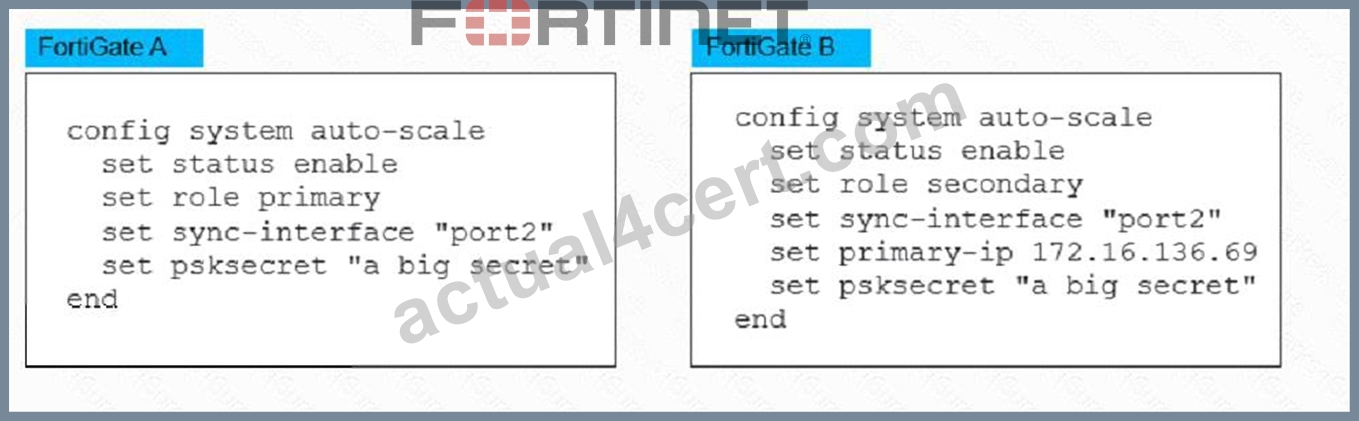
An administrator deployed an HA active-active load balance sandwich in Microsoft Azure. The setup requires configuration synchronization between devices- What are two outcomes from the configured settings? (Choose two.)
- A. By default, FortiGate uses FGCP
- B. FortiGate A and FortiGate B are two independent devices.
- C. It does not synchronize the FortiGate hostname
- D. FortiGate-VM instances are scaled out automatically according to predefined workload levels.
Answer: B,C
Explanation:
B: FortiGate A and FortiGate B are two independent devices. This means that they are not part of a cluster or a high availability group, and they do not share the same configuration or state information. They are configured as standalone FortiGates with standalone configuration synchronization enabled1. This feature allows them to synchronize most of their configuration settings with each other, except for some settings that identify the FortiGate to the network, such as the hostname1. D. It does not synchronize the FortiGate hostname. This is one of the settings that are excluded from the standalone configuration synchronization, as mentioned above. The hostname is a unique identifier for each FortiGate device, and it should not be changed by the synchronization process1.
The other options are incorrect because:
* FortiGate-VM instances are not scaled out automatically according to predefined workload levels. This is a feature of the auto scaling solution for FortiGate-VM on Azure, which requires a different deployment and configuration than the one shown in the exhibit2. The exhibit shows a static deployment of two FortiGate-VM instances behind an Azure load balancer, which does not support auto scaling.
* By default, FortiGate does not use FGCP. FGCP stands for FortiGate Clustering Protocol, which is used to synchronize configuration and state information between FortiGate devices in a cluster or a high availability group3. However, the exhibit shows that the FortiGates are not in a cluster or a high availability group, and they use standalone configuration synchronization instead of FGCP.
NEW QUESTION # 50
Refer to the exhibit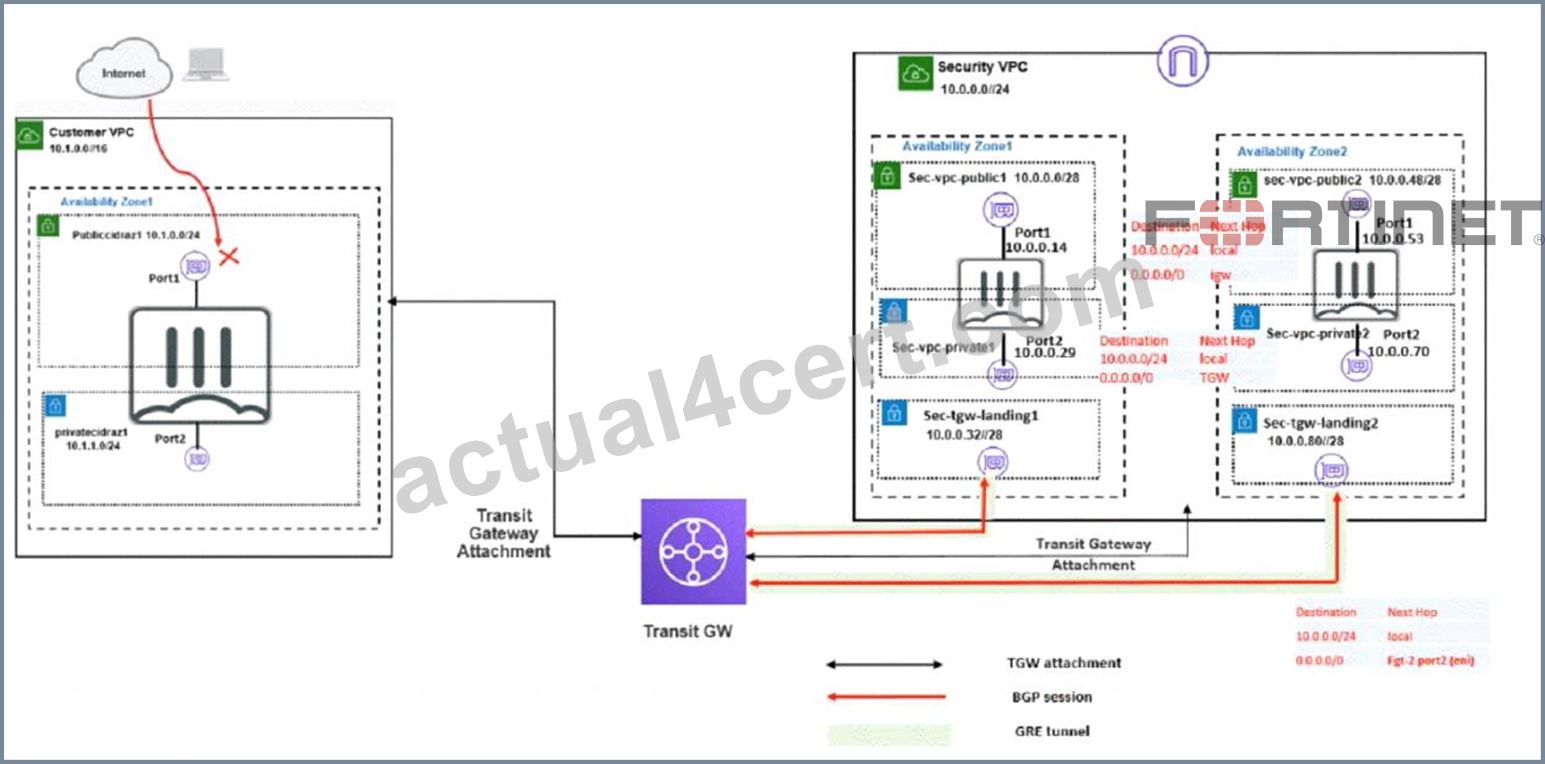
In your Amazon Web Services (AWS), you must allow inbound HTTPS access to the Customer VPC FortiGate VM from the internet However, your HTTPS connection to the FortiGate VM in the Customer VPC is not successful.
Also, you must ensure that the Customer VPC FortiGate VM sends all the outbound Internet traffic through the Security VPC How do you correct this Issue with minimal configuration changes?
(Choose three.)
- A. Deploy an internet gateway, associate an EIP in the public subnet, and attach the internet gateway to the Customer VPC,
- B. Add route destination 0 0.0 0/0 to target the transit gateway
- C. Add a route With your local internet public IP address as the destination and target internet gateway
- D. Add a route With your local internet public IP address as thedestination and target transit gateway
- E. Deploy an internet gateway, associate an EIP in the private subnet, edit route tables, and add a new route destination 0.0.0.0/0 to the target internet gateway
Answer: A,B,E
Explanation:
Explanation
B: Add route destination 0.0.0.0/0 to target the transit gateway. This will ensure that the Customer VPC FortiGate VM sends all the outbound internet traffic through the Security VPC, where it can be inspected by the Security VPC FortiGate VMs1. The transit gateway is a network device that connects multiple VPCs and on-premises networks in a hub-and-spoke model2. D. Deploy an internet gateway, associate an EIP in the private subnet, edit route tables, and add a new route destination 0.0.0.0/0 to the target internet gateway. This will allow inbound HTTPS access to the Customer VPC FortiGate VM from the internet, by creating a public route for the private subnet where the FortiGate VM is located3. An internet gateway is a service that enables communication between your VPC and the internet4. An EIP is a public IPv4 address that you can allocate to your AWS account and associate with your resources. E. Deploy an internet gateway, associate an EIP in the public subnet, and attach the internet gateway to the Customer VPC. This will also allow inbound HTTPS access to the Customer VPC FortiGate VM from the internet, by creating a public route for the public subnet where the FortiGate VM is located3. This is an alternative solution to option D, depending on which subnet you want to use for the FortiGate VM.
The other options are incorrect because:
Adding a route with your local internet public IP address as the destination and target transit gateway will not allow inbound HTTPS access to the Customer VPC FortiGate VM from the internet, because it will only apply to traffic coming from your specific IP address, not from any other source on the internet1. Moreover, it will not ensure that the outbound internet traffic goes through the Security VPC, because it will only apply to traffic going to your specific IP address, not to any other destination on the internet1.
Adding a route with your local internet public IP address as the destination and target internet gateway will not allow inbound HTTPS access to the Customer VPC FortiGate VM from the internet, because it will bypass the Security VPC and send the traffic directly to the Customer VPC1. Moreover, it will not ensure that the outbound internet traffic goes through the Security VPC, because it will only apply to traffic going to your specific IP address, not to any other destination on the internet1.
NEW QUESTION # 51
Refer to the exhibit.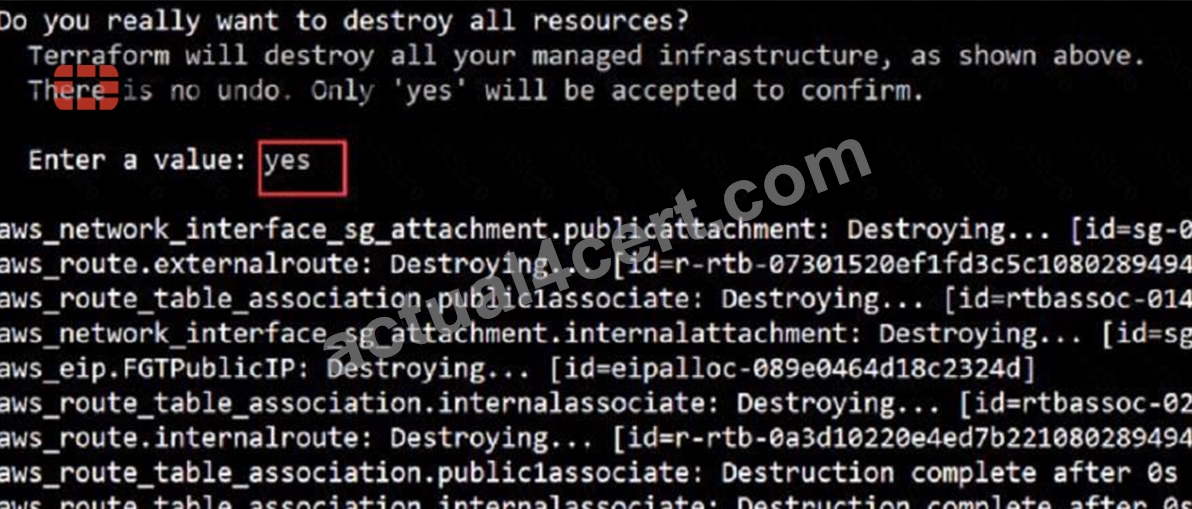
What would be the impact of confirming to delete all the resources in Terraform?
- A. It destroys all the resources in the resource group
- B. It destroys all the resources in the . tfvars file
- C. It destroys all the resources in the state file.
- D. It destroys all the resources tied to the AWS Identity and Access Management (1AM) user.
Answer: C
Explanation:
Confirming to delete all the resources in Terraform will have the following impact:
D:It destroys all the resources in the state file.
* Terraform State File Role:Theterraform.tfstatefile contains a real-time mapping of the resources that Terraform manages, including their current configuration and relationships. This file tracks the actual state of resources provisioned by Terraform.
* Impact of Destruction:When Terraform prompts for confirmation to destroy resources, and 'yes' is entered, Terraform reads the state file and systematically removes all the resources that are managed as part of that state. This is not limited to a specific .tfvars file, IAM user, or resource group-it is a global action that affects all resources tracked by the state file associated with the current Terraform workspace and configuration.
References:The function of theterraform.tfstatefile and the impact of resource destruction are detailed in Terraform's official documentation. This behavior is fundamental to how Terraform manages infrastructure as code.
NEW QUESTION # 52
When an organization deploys a FortiGate-VM in a high availability (HA) (active/active) architecture in Microsoft Azure, they need to determine the default timeout values of the load balancer probes.
In the event of failure, how long will Azure take to mark a FortiGate-VM as unhealthy, considering the default timeout values?
- A. 20 seconds
- B. 30 seconds
- C. 16 seconds
- D. Less than 10 seconds
Answer: D
Explanation:
- If your application produces a time-out response just before the next probe arrives, the detection of the events will take 5 seconds plus the duration of the application time-out when the probe arrives. You can assume the detection to take slightly over 5 seconds.
- If your application produces a time-out response just after the next probe arrives, the detection of the events won't begin until the probe arrives and times out, plus another 5 seconds. You can assume the detection to take just under 10 seconds.
Assume the reaction to a time-out response will take a minimum of 5 seconds and a maximum of
10 seconds to react to the change.
NEW QUESTION # 53
......
Updated Test Engine to Practice NSE7_PBC-7.2 Dumps & Practice Exam: https://pass4sure.actual4cert.com/NSE7_PBC-7.2-pass4sure-vce.html